Become your own boss by starting a NEMT business

  • Niche Market Boom: The elderly population is going to double by 2030.

  • Medical Industry Boom: The medical industry will exceed 20% GDP by 2025.

  • NEMT Boom: The non-emergency medical transportation (NEMT) industry is expected increase from $8 to $30 BILLION by 2030.

  • Recurring Revenue Model: Dialysis patients and other require transportation multiple times per week, creating predictable, repeat income.

Happy older adults gathered together outdoors

What is non emergency medical transportation (NEMT)?Unlike emergency transportation, NEMT services do not require any lifesaving skills or equipment. Although we do provide assisted ambulatory, wheelchair and non-emergency stretcher transportation, we are not an emergency service. Our assisted transportation services most frequently cater to our growing senior population, those with memory care issues, and those with disability and mobility challenges.

Who do non emergency medical transportation providers help and support?In addition to catering to the assisted transportation needs of our senior and disabled communities, we help support the mission and operation of a wide variety of facilities ranging from hospitals and medical centers to dialysis and outpatient clinics, doctors’ offices, and more. The scenarios are endless because NEMT providers are critical to supporting the daily operations of facilities and strategic partners. Can you imagine what hospitals and rehabilitation facilities would do if they couldn’t discharge patients? How would skilled care and nursing facilities get their residents to necessary appointments? The continuity of their daily operation would grind to a halt! Needless to say, in conjunction with the exploding elderly population, the demand for non-emergency medical transportation is only going to grow.

What are the rates of reimbursement for non emergency medical transportation services?Now that’s a loaded question because there are many variables associated with rates of reimbursement to include the type of patient (private pay versus Medicaid, workers comp, VA, or other), the location of the patient and destination, the mode of transportation (ambulatory, wheelchair or stretcher), the time of day, the number of miles, the level of required assistance, and more. In addition to the growing demand, the good news is there are many different types of clients and forms of payment to include direct pay contracts and service agreements with hospitals and facilities, private pay clients (people paying out of pocket), workers compensation, disability insurance, Medicaid, and Veterans Administration.

What are the requirements for starting a non-emergency medical transportation service?Requirements definitely vary by state. Some states require Operating Authority to be gained and managed at the state level through the Department of Transportation, the Department of Motor Vehicles, the Public Utilities Commission, or the Department of Health. Other states have completely deregulated meaning Operating Authority is no longer administered at the state level and, therefore, is regulated at the county level. Although rules and regulations do vary, we strongly encourage you be diligent and prudent in starting the application process to avoid costly mistakes as a result of much of the "free advice" that is readily available online from people or companies with no real NEMT related experience.

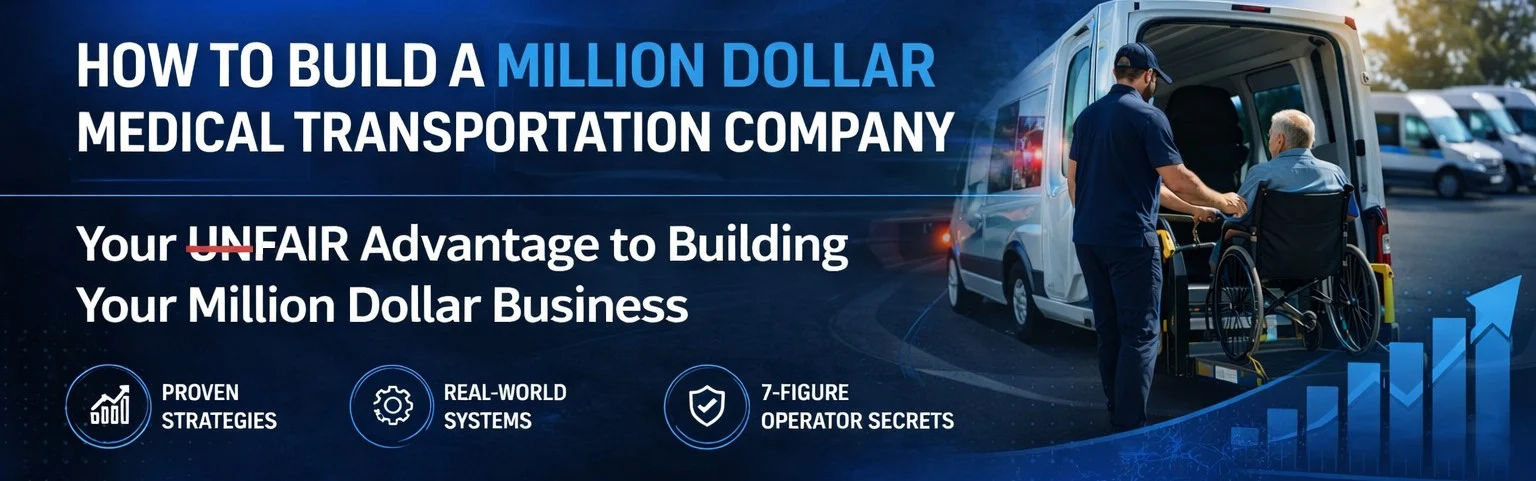
Will Joel's ebook show me how to start and become a successful non-emergency medical transportation provider?Yes, absolutely! That is the entire purpose of Joel's ebook. In addition to providing you with a much greater depth of knowledge and understanding of our growing and changing industry, "How to Build a Million Dollar Medical Transportation Company" is going to teach you how to win strategically and tactically - how setup your daily operation, how to manage customer intake and client relations, how to manage driver and vehicle management, how to create company policies and procedures and so much more so you can increase profitability while decreasing vulnerabilities.

The easiest way to make money is to solve an existing problem. “Find a need and fill it!” No one needs more support services than our growing senior population.

US Elderly Population:

2022: 58 million

2030: 73 million

That's a 26% surge!

FAQ banner

Dear Friend and Fellow Entrepreneur,

Welcome to the non-emergency medical transportation industry! I'm Joel Davis, author of the best- selling "How to Build a Million Dollar Medical Transportation Company" and founder of the United Medical Transportation Providers Group.

As the saying goes, "If you want to make money, just find a need and fill it." Well, when you consider our target market, the elderly population, is literally in the process of doubling in size, yeah, that's hard to ignore!

Let me "spice this up" a bit further and share some of the key points of why starting a non-emergency medical transportation business is such a great opportunity:

  • The elderly population is going to double in size, reaching 70 million, by the year 2030.
  • In addition to the elderly, we cater to the disabled and those with mobility issues of all ages.
  • The medical transportation industry is going to more than double - reaching $20 billion by the year 2030.
  • Hospitals, medical centers, doctor offices, skilled and rehab facilities need you to fulfill their daily mission.
  • There are many different sources of revenue - private pay, direct pay contracts, Medicaid, and more.
  • This is a service-based business meaning no inventory and quickly to launch and get started.
  • This is a unique and uncommon business - most people are unfamiliar with let alone consider starting.
  • This is strictly non-emergency transportation - no special lifesaving skills or training is required.
  • Because of our growing niche market, you can create many community-based strategic partnerships.

I'm sure you already have a strong idea of what's available in your area, but I encourage you to go online and perform a simple 10-mile search to see how many hospitals, medical centers, doctor office, rehabilitation centers, skilled care facilities, assisted and independent living facilities are in your area - and this isn't even considering all of the seniors and those with mobility issues living at home.

I'm sure you already have a strong idea of what's available in your area, but I encourage you to go online and perform a simple 10-mile search to see how many hospitals, medical centers, doctor office, rehabilitation centers, skilled care facilities, assisted and independent living facilities are in your area - and this isn't even considering all of the seniors and those with mobility issues living at home.

There will always be base pick-up fees." This is a fixed charge for the mode of transportation - ambulatory, wheelchair, or stretcher.

Then there are mileage charges. In most instances, mileage will be charged from the point of pick-up, but depending on your location, the type of account or contract, you might include the first 3-5 miles with your base pick-up fee. Regardless, there are two types of mileage fees - "loaded" and "unloaded mileage," or sometimes referred to as "deadhead mileage."

"Loaded mileage" is the per-mile fee for when a patient is traveling onboard. "Unloaded" or "deadhead mileage" is a lower per-mile fee that you will charge for longer trips.

Why would you charge a "deadhead mileage" charge? Because we're dedicated to being profitable which means we always cover our labor costs, added mileage, insurance, maintenance, and wear and tear. Bottom line, because we're committed to growing and scaling, we're not doing anything if it's not profitable.

There are other ancillary charges that we'll continue to discuss in my ebook, but I trust you get this idea that starting a non-emergency medical transportation service is nothing like driving for Uber or Lyft. All too often we are contacted by people suggesting they are an NEMT provider only to find out they are driving their own personal car or sedan as an owner-operator and transporting ambulatory people to medical appointments.

Sorry, but driving rideshare is definitely not the same as a legitimate non-emergency medical transportation company.

Some of you reading this might have experience in driving for Uber, Lyft, or similar rideshare or taxi service. There's absolutely nothing wrong with that, and I'm definitely not trying to belittle you, but as a rideshare or taxi operator, you're basically creating your own job. If you don't get up and work, you don't get paid. In addition to racking up miles, wear and tear on your own vehicle, you're limited by how much you can earn.

You never hear of a rideshare operator selling their business because the rideshare formula is designed to benefit tech companies and not you, the operator. What I'm going to show you in the non-emergency medical transportation industry is how to build, grow, scale, a legitimate business with multiple streams of income that you can sell at a future multiple.

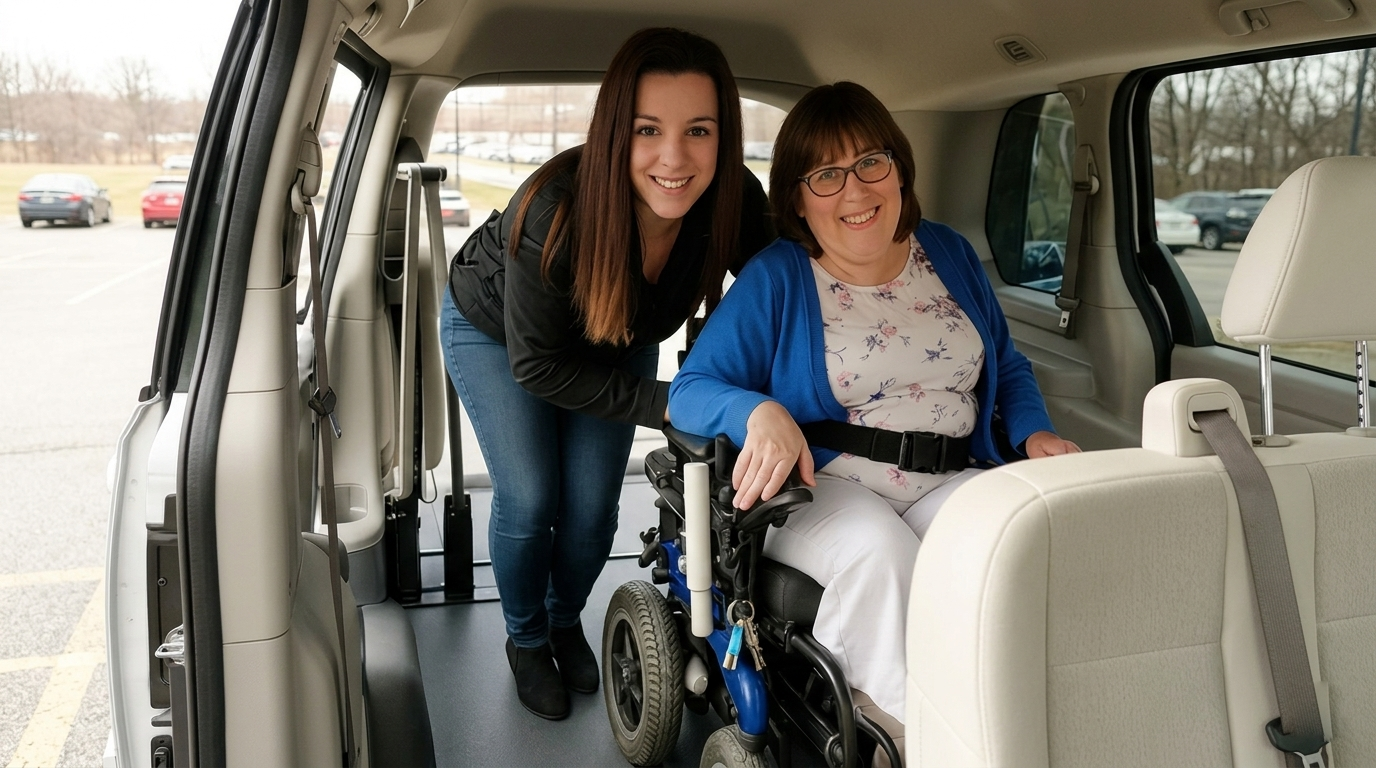
NEMT caregiver helping patient
  • Dialysis: Patients travel to treatments 3 times per week - that's 6 one-way transports per patient!
  • Hospitals: Routinely discharge patients to rehabilitation and skilled care facilities.
  • Facilities: Send patients to doctor appointments and discharge home following rehabilitation.
  • Government Agencies: Wide variety and diverse contract opportunities - everything from mental health facilities, the Veterans Administration, schools, colleges and universities, and more.

Because you're a service-based business providing much needed service, you're literally helping local facilities and residents and WILL become an asset within your community.

Without your service, how would doctors see their elderly and disabled patients? How would seniors get to doctor appointments or receive routine preventive care - especially if living at home with little support?

How would hospitals and skilled care centers turnover their beds to accommodate new patients? The list of scenarios goes on and on, but without your service, their operations would come to a halt!

Elderly woman smiling outdoors
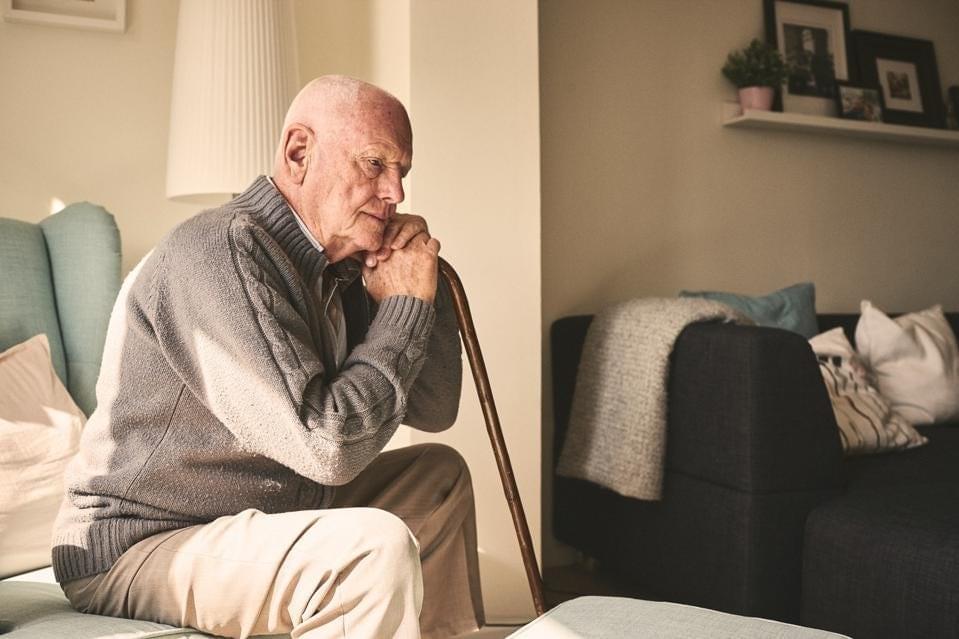
Elderly man sitting alone

There are many elderly people sitting in nursing homes with limited family and even fewer visitors. When you arrive to take them to their medical appointments, in many instances, it's literally their outing for the week, the month, or longer. Your helpful and courteous service-with-a-smile attitude can make a BIG difference!

"Helping one person might not change the world, but it might change the world for one person!"

- Anonymous

Need further incentive or consideration?

Ok, when was the last time you heard someone say, "I think I'm going start a NEMT business?" The fact of the matter is you probably haven't. It's just not a common business idea - which means the market isn't flooded with people stumbling over each other to launch a non-emergency medical transportation business.

Contrast that with all the no-money-down real estate ventures and common online hoopla schemes. I'm highly confident either you or someone you know traveled down the no-money-down real estate road, considered going the Amazon seller routine, maybe even a multi-level marketing scam or two for seasoning? You get the idea.

Trust me, I'm not against real estate or many other money-making ideas. As I always say, "There's a million ways to make a million dollars," but another key aspect that makes me gravitate towards non-emergency medical transportation is the positive cash flow. A strong NEMT business with quality accounts is a very strong and positive cash flowing business - and cash flow is the lifeblood of your business!

When you couple all of these dynamics together—the booming elderly population, exploding healthcare demand, strong cash flow, limited competition, etc.—it all equates to a winning formula. Just consider some of the many different sources of revenue:

PRIVATE PAY CLIENTS:

These are clients who typically pay "out of pocket" for assisted transportation to and from medical appointments. They can originate from their own private residence, an assisted living or independent senior community, residential care facilities, or other.

In building your non-emergency medical transportation business, it's my hope that you focus on building a strong foundation of private pay clientele because the rates of reimbursement tend to be higher as compared to other sources of reimbursement, and you have much greater freedom and flexibility for determining your rates and terms versus having to comply with various regulation from government agencies or entities.

As you'll learn in my material, I encourage you to build a diverse and dynamic business model with multiple sources of profitable revenue, but if the rates of reimbursement are not profitable, you don't provide service!

I continue to work with a growing number of client-providers who only provide private pay and direct pay contracts and service agreement work because of the higher rates of reimbursement. For them, pursing lower forms of reimbursement simply are not worth their time and effort.

A high degree of private pay and direct-pay contracted work will definitely increase your margins and make your business more appealing when it comes time to sell your business.

The scenarios and combinations of source revenue are wide and varied but all realistic.  In working with transportation providers across the country, performing business valuations, and helping many buy and sell, my team and I continue to see unique NEMT business models on a daily basis.

MY STORY & EXPERIENCE

I know, I know, everyone selling something online has an emotional, heartwarming story - a near death experience, overcome drug addiction, victimized in some way, etc.

Folks, I'm sorry, I just don't have that type of story. The best I got is I grew up poor and my dad split when I was 7 years old. Despite that, I was raised by an incredibly loving mother and sisters. I did launch my NEMT business out of my mother's living room, but I wasn't on my last $50 and a bucket of chicken - sorry to disappoint.

I grew up in Binghamton, New York, was captain of my high school football team, and like my two brothers, graduated from the United States Military Academy where I was captain of the 1995 Army Football team. I majored in pre-law and minored in systems engineering.

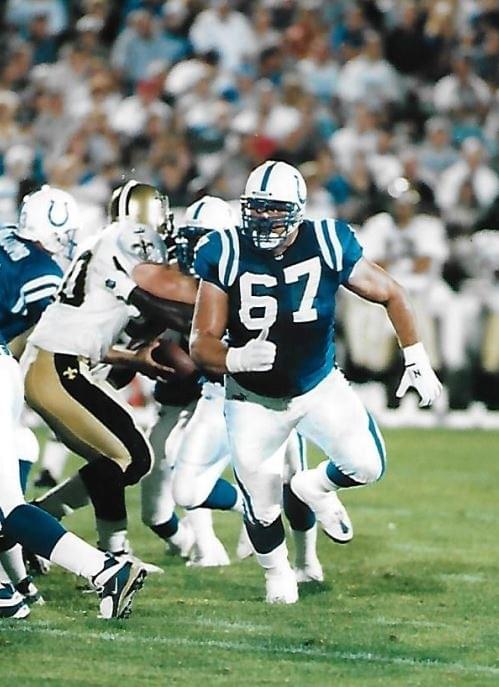
Upon graduation, I was commissioned as a Field Artillery officer and stationed at Ft. Sill, Oklahoma. After receiving an honorable discharge, I traveled to Cincinnati to join the Bengals who I signed with as a free agent my senior year at West Point.

In being released by the Bengals in 1998, I realized the NFL really stood for "Not for Long." If you're not part of the top 2-3% of players making real money in the league, you're just cannon fodder, so keep your bags packed!

While back in Binghamton, a friend who was the Director of Operations of local nursing home gave me the idea to start a non-emergency medical transportation business. Because I knew nothing about the business, I invested approximately two weeks into market research, studied the local demographics, followed my competitors around town to see who they were and where they were going, and it wasn't hard to see the opportunity.

After returning to football and joining the Colts, when I was released in 2000, rather than signing with another team, I returned home and launched my business.

Joel Davis playing football

Again, I know - far from a near death experience, years of rehab, penniless on the street, or anything similar to a tear-jerking drama-filled story readily told online.

However, what I can share with great abundance is that I was complete and total jackass because, despite investing in research and doing my due diligence, I had NO CLUE of what the heck I was doing!

Yes, the opportunity was there. Yes, I was full of motivation and hustle. Yes, I was making money, but this was my first business, and I made a wide variety of costly mistakes - ranging from purchasing the wrong vehicles, partnering with and hiring the wrong people, growing too fast while failing to properly manage my account receivables and losing almost $80,000, and the list goes on and on.

Needless to say, I can definitely claim the title of jackass, but to my defense, I had no one teaching me. West Point definitely doesn't teach a course on scaling a non-emergency medical transportation business let alone anything regarding business management, and there were no ebooks, training videos, seminars, or anyone willing to share the intricate details of the business.

The good news is despite my many mistakes, because of growing market opportunities, I was able to rebound and overcome my losses because I was hustling, and my business was growing. Compound that with effective communication skills and techniques learned while at West Point, and I was able to run circles around my competitors.

My "BIG break" was gaining a BIG contract with three area sister-hospitals - something my competitors could never do. We did all the in-service transports between the two local hospitals and their affiliated centers and their third hospital that was located about 40 miles away. We also had first rights of refusal for all general discharges - for which we rarely, if ever, turned down. We always accommodated because it was good money.

Long story short (as if it wasn't long already!), in 2004 I became divinely inspired to teach others to do exactly what I did - build a million dollar medical transportation company.

Since authoring the first edition of "How to Build a Million Dollar Medical Transportation Company," I've updated it dozens of times to ensure targeted and relevant accuracy. As you can imagine, the industry has changed in so many ways over these many years, and in being blessed to work with so many different client-providers around the country, we've had unique and exclusive access to our industry on a macro scale. We're able to witness firsthand how things are growing and changing from California, to Texas, Florida, New York, Michigan and every state in between!

The key fundamentals you're going to discover in my best-selling ebook:

  • Build: "Assemble the nuts and bolts" of your business to get licensed and operational.
  • Grow: Expand infrastructure and logistics to garner multiple sources of revenue.
  • Scale: Experience substantial increase in revenue to support long-term growth.
  • Prepare for Sale: Increase your overall business valuation to garner a greater asking price and ROI.

START SMALL USING A "CONTROLLED GROWTH" STRATEGY

Trust me, I'm all for growing fast - make as much money as fast as you can! That's the goal, right? However, we need to be pragmatic. Growth has to be done properly and systematically so you don't make the same mistakes I did - lose a chunk of money, waste time and effort, etc. Bottom line, we need to protect your capital investment and cash flow.

In keeping with a "controlled growth" strategy and systematically reinvesting into your business, I encourage you to start your business from your home office. I know that doesn't sound glamours and won't score a lot of drinks at happy hour, but as an NEMT provider, you'll be traveling into your community to meet and service the needs of your clients and facilities. Therefore, it makes no sense to spend necessary capital on a formal office space that you don't need.

You're not a retail business. Save the money, be practical, and start small. There will be plenty of time in the future to rent a separate office space to accommodate dispatchers, allow drivers to congregate, park vehicles, store equipment, etc., but that time is not now while you're first starting.

"Joel's ebook is the best ebook I ever invested in. I wasted $90 on another NEMT ebook which proved to be nothing but preformatted crap I could have got anywhere! Despite that initial setback, I took a chance on Joel's ebook which was the single best investment - I recommend it to anyone serious about the NEMT business."

Gary
- Caring-For-You Transportation

"This is the Bible of the NEMT industry. This ebook gave me my start. I left UPS after 20 years and started my own NEMT business. I have since expanded into courier, rentals, and now the home care industry. I still refer back to Joel's ebook for counsel."

Carlos
- Western Carolina Medical Transportation

"If you are serious about being successful in the NEMT business then this is a must read. I hesitate to buy things online but I couldn't pass this opportunity up. I am glad I didn't. I continue to study Joel's material and follow his step by step advice and study his DVDs. I recommend Joel's material from first hand experience."

Robert
- Wilkes & Miller Enterprises, Inc.

IMPORTANT

Be very cautious of the information you consume - wrong advice is costly advice!

There is a great deal of misleading and outright false information online regarding the NEMT industry. Tech companies are eager to get as many subscribers as possible to use their software platforms. Plenty of online marketers are advertising NEMT resources, yet very few have any real, credible, or direct industry experience.

Despite what online charlatans advertise, success in the non-emergency medical transportation industry is not a get-rich-quick scheme! Success in this industry requires sound strategic planning, dedicated work and effort, sincere compassion and a desire to serve the elderly and disabled communities.

Rules and regulations vary between states and sources of revenue. Anyone suggesting you start your NEMT business as a "side hustle" or all you need to start and grow is "get some vehicles, insurance, and promote your service with business cards" - RUN as fast and as far away from them as possible!

If you're part of the 80% who have thought about starting your own business but haven't found the right opportunity, then look no further. In my ebook, I'm going to share all of the "nuts and bolts" needed to get your business operational as cost-effective as possible.

If you're a caring and compassionate person and can truly appreciate helping others, then non-emergency medical transportation could be the right opportunity for you.

The NEMT industry has been a phenomenal opportunity for me and our many client-providers, and it can be for you. The key is to build your business "the right way" from the very beginning to avoid costly mistakes.

If there's one thing my team and I know, it's the NEMT industry. We work with client-providers on a daily basis - helping them to build, grow and scale, negotiate and prepare contracts and services agreements, and work with buyers and sellers from around the country.

If my strategies, tactics and techniques can work for others, they can definitely work for you. All I need from you is motivation, a willingness to learn, and action!

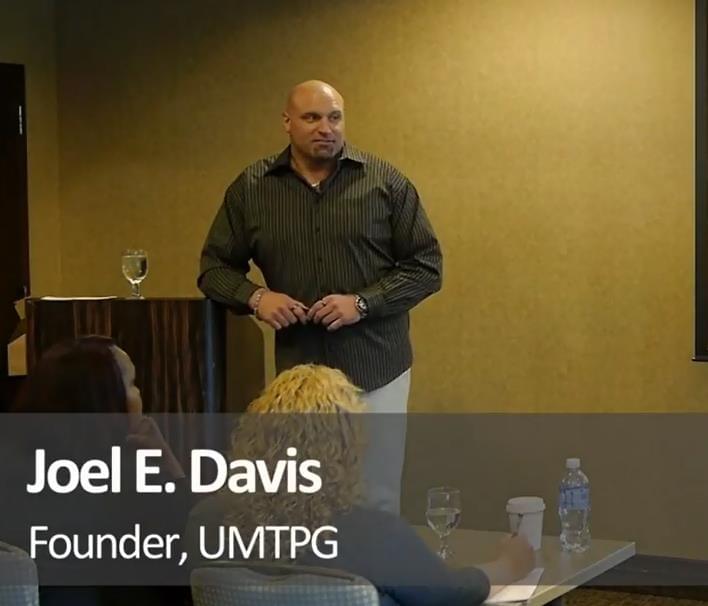
Joel E. Davis speaking

REMEMBER: Your business is non emergency transportation. This is not complicated. You are not a medical professional and are not rendering direct patient care. Your only requirement is to be timely, courteous, and helpful!

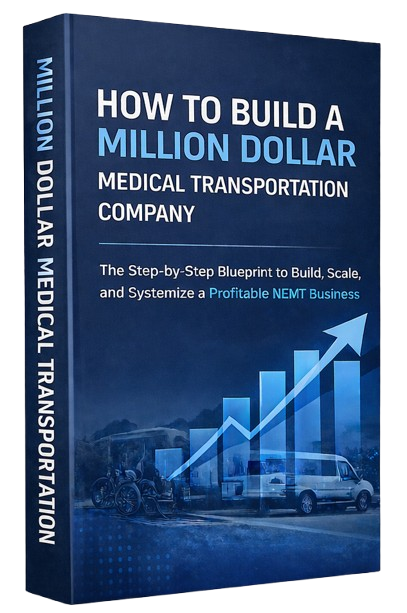
How to Build a Million Dollar Medical Transportation Company ebook cover

There aren't too many ebooks on the market of this size, 325-pages, but it's not about size that matters, it's quality! Needless to say, this foundational resource is full of industry specific details versus a bunch of feel-good fluff that leaves you asking yourself "What do I do next?"

To underscore our commitment to your success, if you have any questions about this resources or associated information, contact us at.

support@milliondollartransportation.com.

ONLY $97.95!

Click Here to Invest in Joel's EBook

See you at the Top!

Joel E. Davis

PS: Take all the time you need to surf this site, watch videos, read through comments and testimonials, and contact us with questions. Share your information via "Contact Us" page or by email at support@milliondollartransportation.com.

I would like to share my experience with Joel Davis for anyone thinking about starting an NEMT business and enlisting Joel's help.

My business partner and I started our company in 2014. We purchased Joel's material and studied his DVDs. We were off to a great start and doing very well when, tragically, my partner unexpectedly passed away in 2016. This was a very difficult time for our company and respective families.

Further complicating this difficult ordeal was the unexpected legal battle between my business partner's widow and our company. Without disclosing all of the associated details, they claimed our business was valued at much more than it was. Had they won, we would have had no choice but to sell immediately or close our doors.

Not sure of what to do, I reached out to Joel and retained his services. Joel performed an executive business valuation for our company and worked closely with my attorney. Joel's findings directly refuted what the plaintiff, their attorney and their business broker claimed our business was worth. This legal dispute went to trial in early 2018 and Joel was called to testify as an industry expert and to provide testimony of the value of our company at the time of my partners passing. In April 2018 we received the judge's ruling who agreed with Joel's valuation of our business. Needless to say, Joel's help was critical in helping us keep our business and bring this lengthy and costly legal dispute to a close.

I cannot thank Joel enough. We used Joel's information to get started, which was great, but nothing compared to his help when we needed it most. Joel really is The Authority in the NEMT industry and I encourage everyone to listen to his advice. I know everyone claims to be a guru or an expert and there is a lot of stuff online, but I encourage you to consider the source because when you least expect it you might need real help. After personally working with Joel during this difficult time and relying on his expert testimony, I gladly tell everyone Joel is the real deal.

Thank you,
Richard, Texas (Business Owner)

Email Testimonial: